Landmark annotation delivered at scale with 10+ years of experience, 540+ trained annotators, and 38M+ images processed, ISO, HIPAA, and GDPR-aligned

Landmark annotation supplies exact coordinates for key points and reference markers in images and video. These labels support object localization, spatial alignment, and 3D reconstruction—capabilities used in autonomous navigation, facial and hand analysis, AR, sports analytics, and imaging. Quality landmarks reduce model errors, strengthen spatial understanding, and speed deployment.
Precise BPO India combines 10+ years of experience with 540+ annotators to deliver scalable landmark datasets. Our workflows fit SBU, MBU, and enterprise needs: we define taxonomies, point structures, and labeling rules so each coordinate matches client and model requirements.
We have processed 810M+ images across all projects, including 38M+ landmark tasks across automotive, healthcare, retail, agriculture, geospatial, sports, robotics, and industrial AI. This scale helps clients train large models, manage lifecycles, and iterate consistently across versions. Security and quality are core.
We implement ISO 27001 controls and follow GDPR- and HIPAA-aligned practices where needed. Multi-stage QC—automated checks, reviewer audits, and sampling—maintains accuracy for high-volume datasets and specialized workflows.
Serving the US, UK, EU, ME, APAC, LATAM and global markets, Precise BPO India provides India-based, cost-efficient landmark annotation that improves spatial accuracy and accelerates production AI. From face and hand landmarking for gesture and expression analysis to sports action landmarks, AR point mapping, and 3D reference markers, we deliver consistent, model-ready datasets.



Key point mapping for vehicles, lanes, pedestrians, curbs, and road elements for navigation AI.
Anatomical landmarks for diagnostics, surgical planning, and AI-assisted imaging.
Product corner detection, shelf markers, and AR-ready landmark datasets for automation.
Crop, canopy, and terrain landmark mapping from aerial and satellite imagery for analytics AI.
Roof corners, land parcel markers, terrain points, and environmental references for GIS mapping.
Landmark detection for mechanical parts, assembly lines, and object positioning in automation AI.

Multi-point landmarking – Manually label multiple anatomical or object reference points in crowded or overlapping scenes.
Precise coordinate tracing – Accurately assign coordinate values to each landmark for alignment, measurement, and spatial analysis.
Occlusion-aware landmark labeling – Identify and annotate partially hidden landmarks using contextual visual cues.
Dense landmark mapping – Handle images and frames containing a high number of closely spaced keypoints.
3D & depth-aware landmark labeling – Apply multi-dimensional landmark annotations for pose estimation, motion analysis, and spatial understanding.
Instance & semantic landmark annotation – Assign landmarks at both individual-object and class-level structures using defined labeling rules.
Custom landmark taxonomy definition – Design landmark sets, naming conventions, and structural rules tailored to project requirements.
Scalable landmark annotation workflows – Manage high-volume landmark datasets using structured task allocation and multi-stage review.

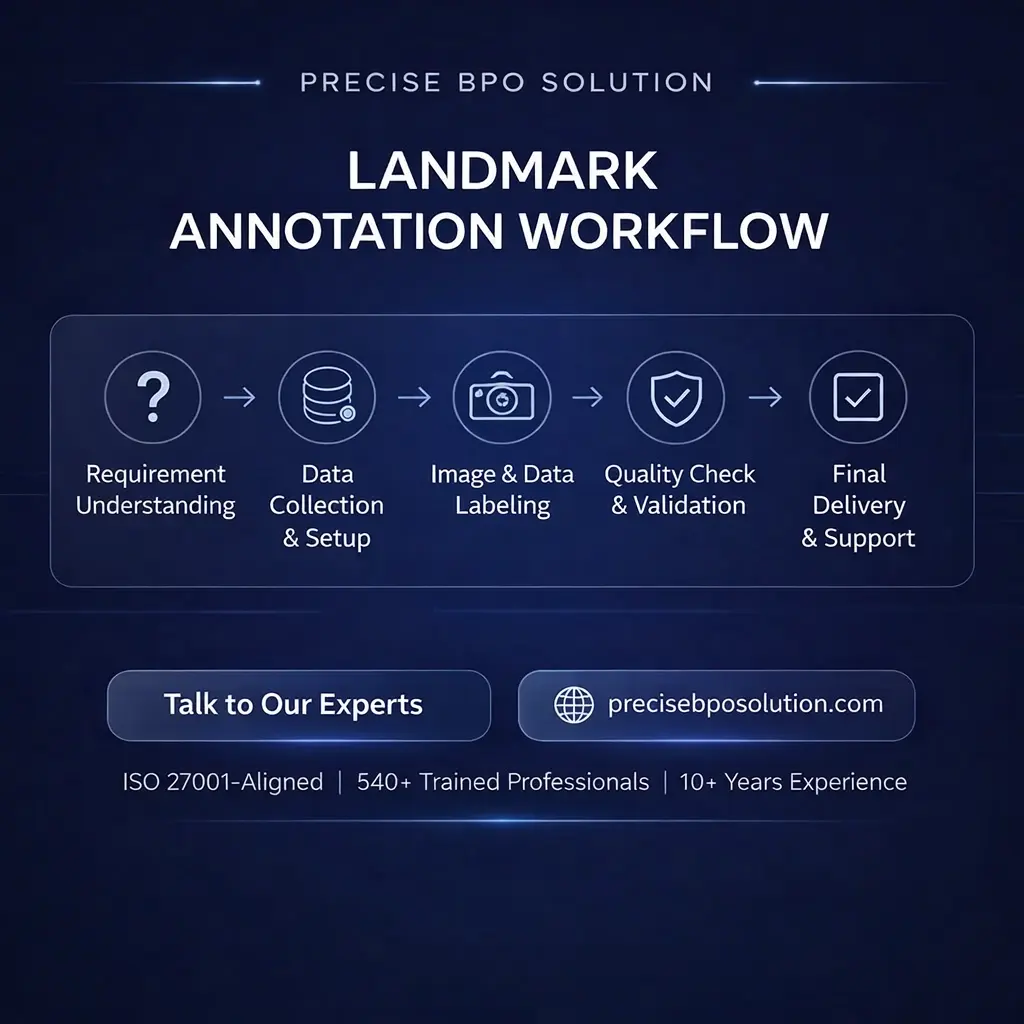
Requirement Understanding
Define project goals, landmark types, labeling rules, and point-placement standards with clients.
Data Collection & Setup
Curate, clean, and prepare images/videos for high-quality annotation inputs.
Data Labeling
Annotators add key points, coordinates, and reference markers based on client rules.
Quality Check
Multi-layer QC combining automated checks and human review ensures accuracy.
Client Review
Incorporate client feedback, refine landmark rules, and adjust workflow.
Final Delivery & Support
Deliver datasets in requested formats and provide scalable support for enterprise AI pipelines.

Client Need:
Accurate road, lane, and vehicle reference points for ADAS.
Solution:
High-quality landmark coordinates with multi-layer QC.
Result:
Model accuracy improved 22%, reducing navigation errors.
Client Need:
Anatomical landmarks for surgical planning and diagnostic AI.
Solution:
HIPAA-aligned landmark annotation with precise coordinates.
Result:
Detection sensitivity increased 18%, improving patient outcomes.
Client Need:
Facial keypoints and hand landmarks for gesture, gaze, and expression analysis.
Solution:
Dense multi-point face and hand landmarking with occlusion handling and temporal consistency.
Result:
Recognition models achieved higher precision with fewer false positives.
Client Need:
Player movement and action tracking for analytics and highlight generation.
Solution:
Joint, limb, and motion landmarking with frame-to-frame tracking.
Result:
Player-action models delivered improved recall and better event detection.
Client Need:
Mechanical parts and assembly line positioning for automation.
Solution:
Dense landmarking for occluded and overlapping components.
Result:
Pick-and-place accuracy improved 30%, reducing defects.

✔ 10+ years of landmark annotation experience supporting AI pipelines globally.
✔ 540+ skilled annotators delivering high-volume, precise datasets efficiently.
✔ Proven experience with SBU, MBU, and enterprise-level projects. 38M+ images processed with high-accuracy landmarking.
✔ ISO, HIPAA, and GDPR-aligned workflows ensuring secure, secure handling.
✔ Indian-based, high-volume, low-cost solutions for global AI teams.
✔ Flexible taxonomy, multi-class labeling, instance, and hierarchical point-setup support.
✔ Multi-stage QC combining human and automated verification guarantees consistent datasets.
✔ Dedicated client support and ongoing workflow optimization for enterprise projects.
✔ Scalable solutions for urgent or large-volume landmark annotation projects.
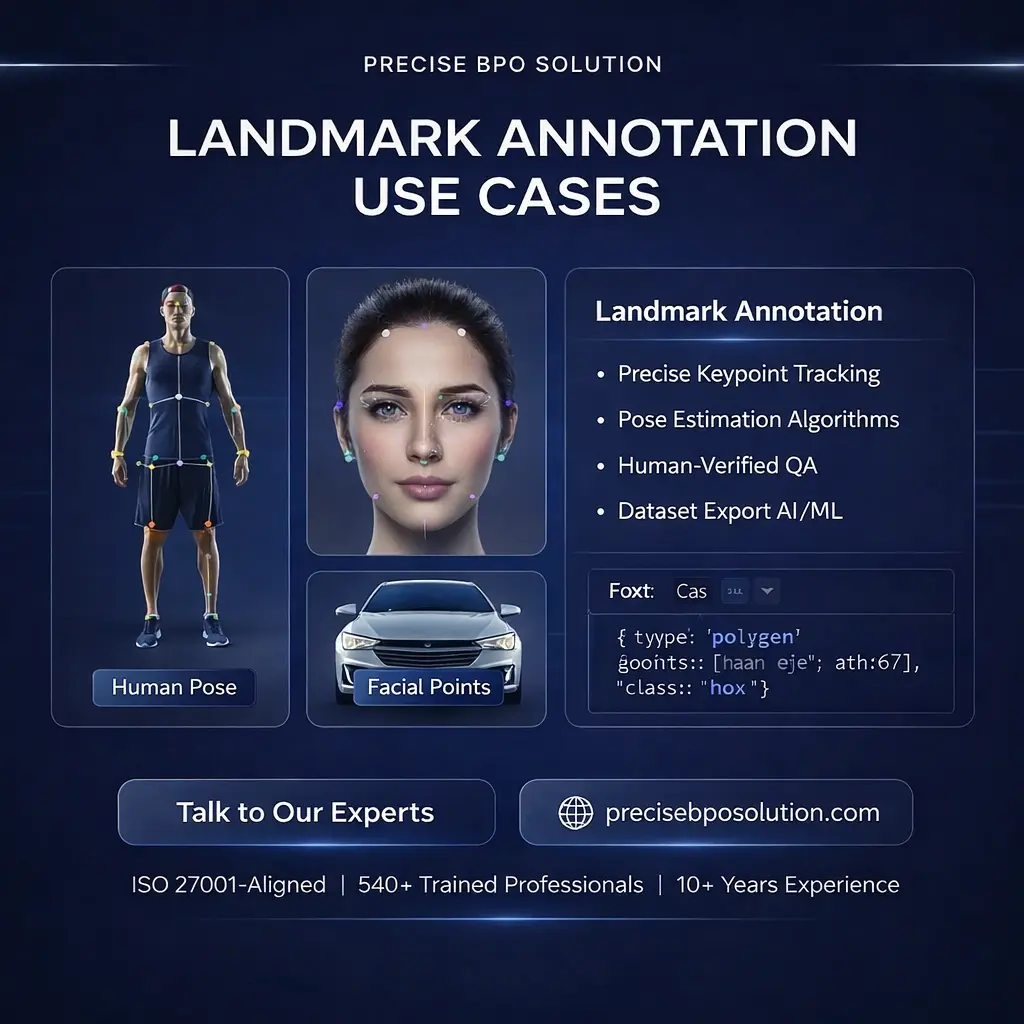
Landmark annotation involves marking precise key points on objects, people, or environments within images or videos. These reference points help AI systems understand structure, position, and movement. Landmark data is widely used for facial analysis, pose estimation, gesture recognition, medical imaging, robotics, and autonomous systems that require spatial accuracy.
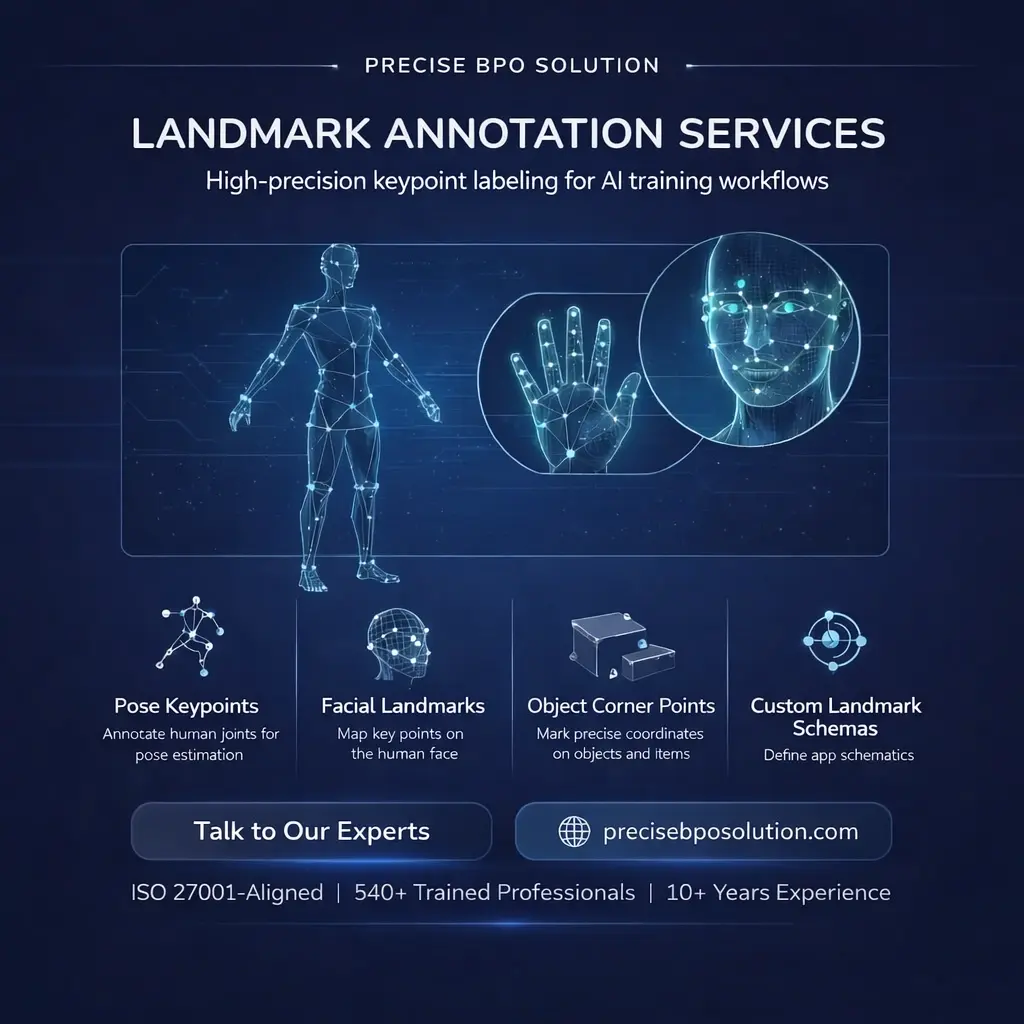
Landmark annotation can cover facial points, hand joints, body pose landmarks, object reference points, road features, and structural markers. These points may represent edges, joints, corners, or motion anchors. Such annotations support applications like AR/VR, sports analytics, robotics, medical imaging, and vision-based AI models requiring coordinate-level precision.
Landmark annotation services support long-term projects by maintaining consistent point definitions across batches and timeframes. This allows datasets to grow without breaking model logic. Teams can continuously add new images or videos while preserving alignment with earlier annotations, enabling model retraining, refinement, and version updates as projects evolve.
Landmark annotation is used across automotive, healthcare, retail, sports analytics, robotics, agriculture, geospatial mapping, and AR/VR development. These industries rely on keypoint data to interpret motion, structure, and spatial relationships, helping improve accuracy in perception models, simulations, diagnostics, and real-time decision systems.
Consistency is maintained by applying predefined landmark definitions, point placement rules, and review standards across all batches. Annotators follow the same reference logic for similar objects, ensuring uniform placement over time. This helps reduce variation, supports stable model training, and improves reliability when datasets expand or are reused.
Landmark datasets are commonly delivered in formats such as JSON, XML, COCO, CSV, or other client-defined schemas. These formats integrate easily with training pipelines, visualization tools, and evaluation frameworks. Output structures are aligned to support model training, testing, and version updates without requiring reformatting.
Yes. Landmark annotation is often structured to support continuous or high-volume data flows. Teams can handle recurring uploads, expanding datasets, and evolving annotation requirements over time. This approach supports long-term AI development, seasonal scaling, and iterative model improvement without disrupting consistency or delivery cadence.
Pricing usually depends on factors such as point density, annotation complexity, data volume, and turnaround needs. Common models include per-image, per-keypoint, per-task, hourly, or project-based pricing. This flexibility allows teams to align costs with project scope, development stage, and long-term dataset planning.
AI Website Generator