Bounding box labeling with 10+ years of experience, 540+ annotators, and 390M+ images processed, using ISO, HIPAA and GDPR aligned workflows

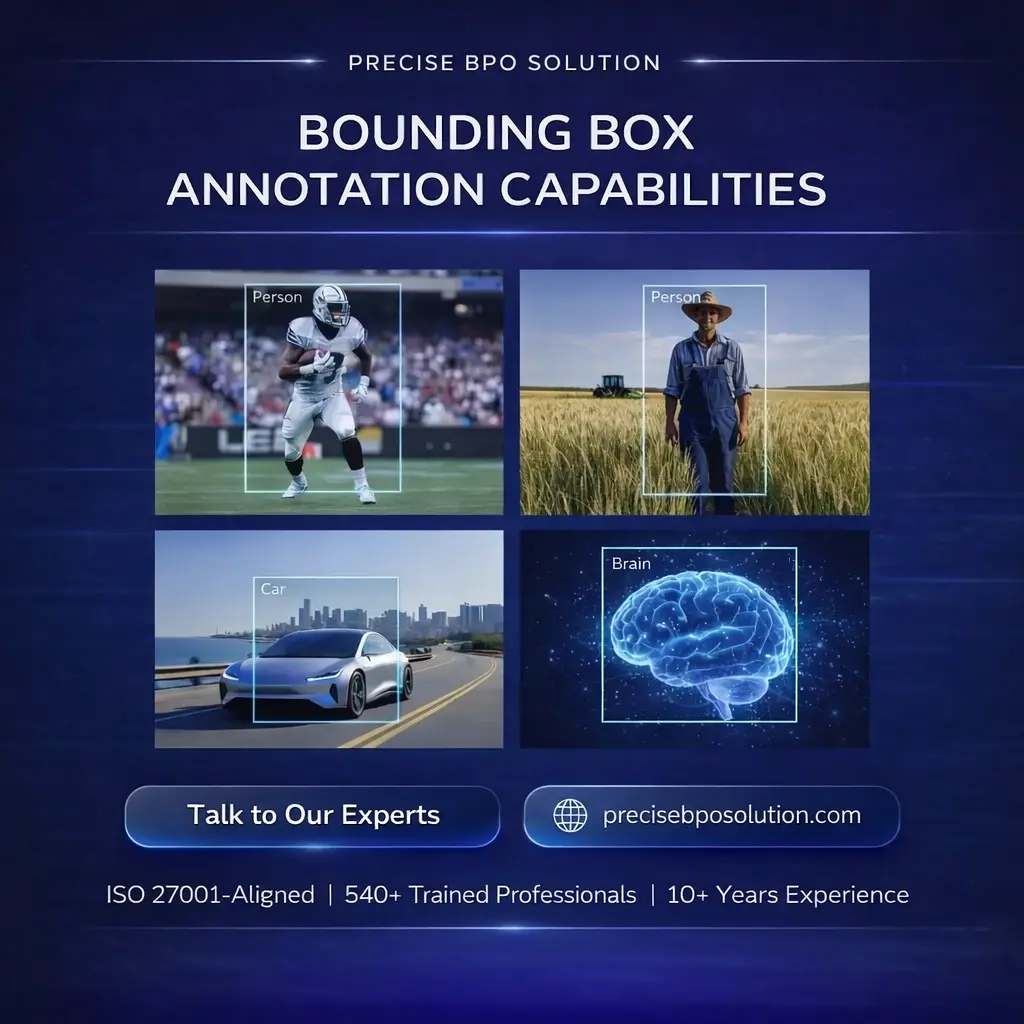
Bounding box annotation provides precise object-level labeling for detection, tracking, and localization tasks across images and videos. These carefully drawn boxes define object boundaries, improve detection accuracy, support multi-class classification, and enhance AI model performance in computer vision pipelines. High-quality bounding boxes reduce false positives, improve recall, and accelerate enterprise AI deployment.
Precise BPO India combines 10+ years of experience with 540+ expert annotators to deliver large-scale object detection labeling, object detection datasets, and AI labeling services for global AI teams. Our workflows cover SBU, MBU, and enterprise projects, including class hierarchy setup, annotation guidelines, placement rules, IoU standards, and frame-level annotation quality checks to ensure consistency across object types and environments.
We have processed 810M+ images across various projects, including 390M+ object-level labeling tasks across automotive, healthcare, retail, agriculture, geospatial, sports, robotics, and industrial AI domains. This massive dataset volume supports training advanced detection models, multi-stage AI pipelines, and versioned workflows while maintaining high accuracy and strict data security.
ISO-aligned controls, automated audits, IoU scoring, reviewer checks, and sampling guarantee precise, high-volume object detection annotation. Serving US, UK, EU, ME, APAC, and LATAM, Precise BPO India delivers scalable, cost-efficient object detection datasets and AI labeling services for global enterprise AI projects.


Vehicles, pedestrians, lanes, signage, obstacles, and road objects precisely boxed to enhance navigation, perception, and autonomous AI pipelines.
Lesions, abnormalities, tools, instruments, organs, and clinical objects boxed for diagnostic detection, surgical planning, and radiology AI models.
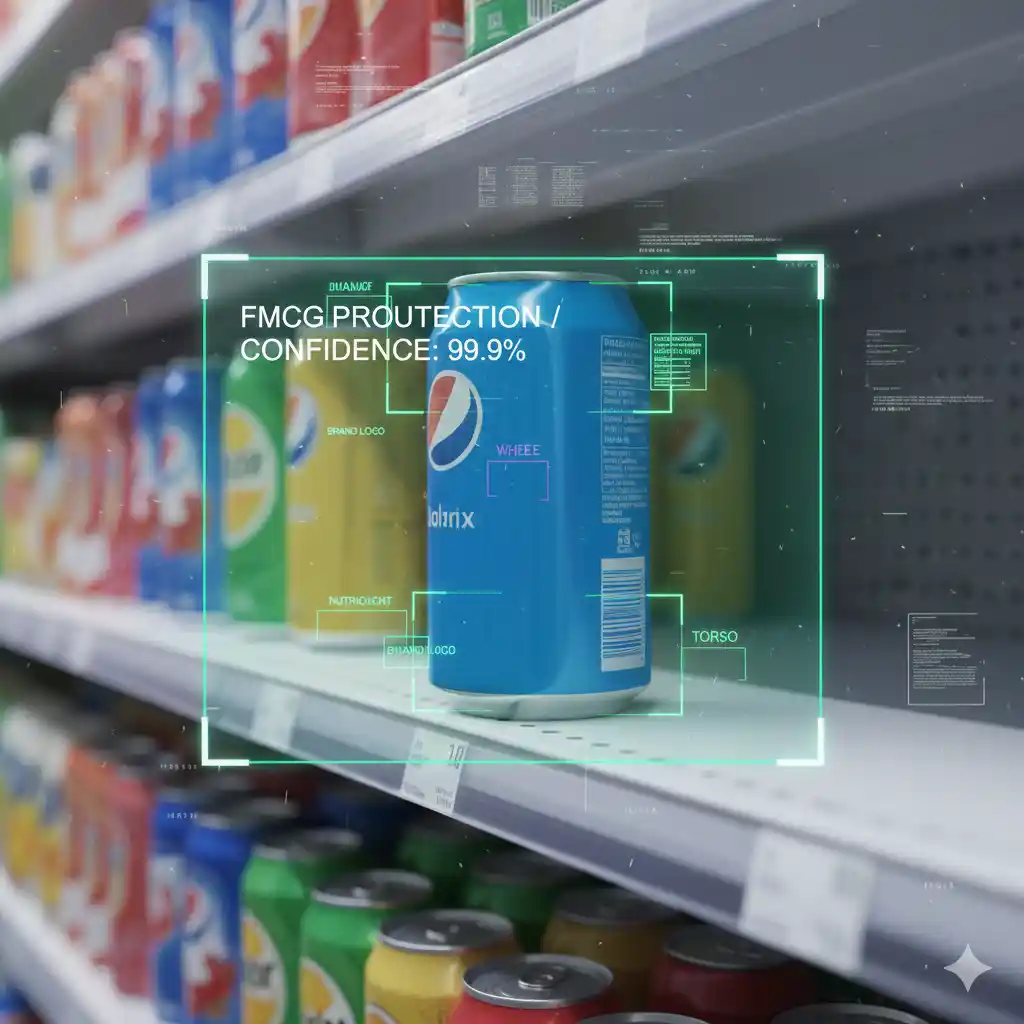
Products, shelves, packaging, barcodes, and layouts boxed for inventory automation, AR-based price-tag detection, and retail analytics.
Crops, fruits, pests, trees, livestock, and field objects boxed from drone and satellite imagery to optimize yield and support precision farming.
Buildings, vehicles, rooftops, road objects, and terrain features boxed for GIS platforms, aerial mapping, and satellite-based land analysis projects.
Parts, tools, defects, components, equipment, and machinery boxed for robotic guidance, QC automation, and industrial assembly vision systems.
Objects, surfaces, furniture, tools, and moving elements boxed to enhance spatial understanding, calibration, and immersive 3D AI environments.
Fish, marine animals, debris, nets, and underwater objects boxed from ROV/AUV footage to support aquaculture, species detection, and ocean monitoring.

✔ Tight bounding boxes — Precisely capture object boundaries using clearly defined IoU and placement rules.
✔ Multi-class detection — Label multiple object categories within the same image or video frame.
✔ Tracking support — Maintain consistent bounding boxes across video frames for temporal continuity.
✔ Occlusion handling — Annotate partially hidden, overlapping, or densely grouped objects with clear labeling logic.
✔ High-density object processing — Handle images containing many objects while maintaining consistency and accuracy.
✔ Rotated bounding boxes (if required) — Support angled or oriented box annotations where object geometry requires it.
✔ Class taxonomy setup — Define custom class lists, hierarchies, and labeling rules based on project needs.
✔ Enterprise workflows — Manage SBU, MBU, and large-scale volumes through structured task allocation and review processes.
✔ Multi-stage QC — Apply IoU checks, overlap reviews, sampling, and human validation to ensure consistent object labeling quality.

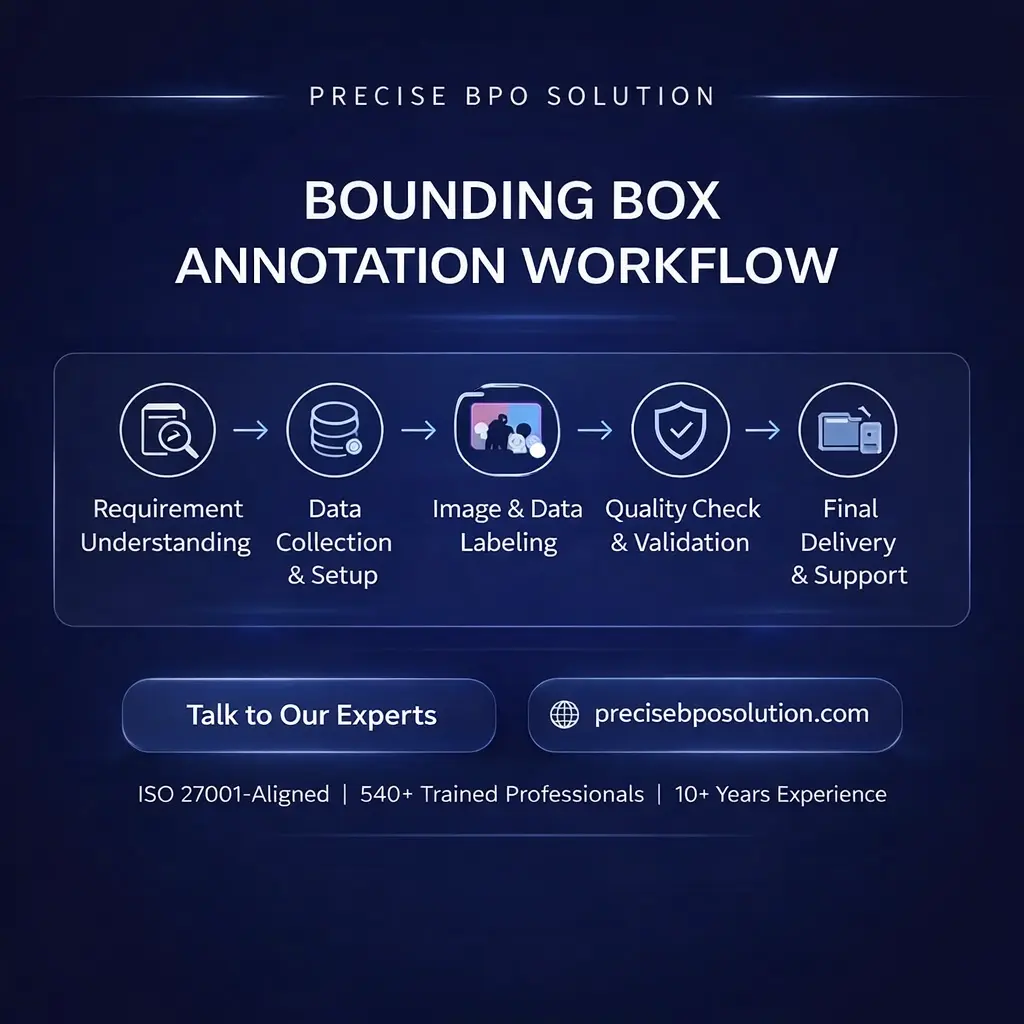
Requirement Understanding
Define detection goals, object classes, annotation rules, IoU thresholds, and box placement standards.
Data Collection & Setup
Prepare and preprocess images/videos, normalize formats, and structure datasets for efficient box labeling.
Data Labeling
Annotators draw precise box-level labels per object class, ensuring IoU alignment, correct box tightness, and consistency.
Quality Check
IoU validation, box consistency checks, reviewer audits, automated QC, and expert review guarantee dataset accuracy.
Client Review
Integrate feedback, refine box rules, update class lists, and adjust sampling or detection standards per client needs.
Final Delivery & Support
Deliver bounding box datasets in JSON, XML, VOC, COCO, YOLO, or other formats and support high-volume AI pipelines.

Client Need:
Detect vehicles, pedestrians, and road objects for ADAS.
Solution:
Multi-class bounding boxes with IoU-based QC.
Result:
Detection accuracy improved 23%, reducing false positives.
Client Need:
Box-level detection of lesions and clinical targets.
Solution:
Precision-aligned bounding boxes with reviewer validation.
Result:
Diagnostic recall increased 18%, improving workflow reliability.
Client Need:
Product and shelf-object detection for AR and inventory automation.
Solution:
High-density bounding boxes with automated QC audits.
Result:
Model training speed improved 20%, reducing labeling errors.
Client Need:
Crop, fruit, and pest detection from drone imagery.
Solution:
Multi-class, occlusion-aware bounding boxes.
Result:
Prediction accuracy increased 21%, supporting precision farming.
Client Need:
Parts, tools, and defect detection for robotic vision.
Solution:
Instance-consistent bounding boxes with strict IoU rules.
Result:
Assembly guidance accuracy improved 28%, enabling efficient automation.

✔ 10+ years of bounding box labeling experience serving global AI teams.
✔ 540+ trained annotators delivering scalable, high-volume object detection datasets.
✔ 390M+ bounding box images processed across multiple industries.
✔ ISO, HIPAA & GDPR-aligned workflows with secure access control.
✔ Cost-efficient India-based annotation teams supporting US, UK, EU, ME, and APAC regions.
✔ Custom class lists, multi-class detection, tracking support, and flexible enterprise workflows.
✔ Multi-stage QC combining IoU scoring, audits, and expert review.
✔ Dedicated support and continuous delivery for large-volume detection pipelines.
✔ Highly scalable operations for urgent, enterprise-scale projects.
Bounding box annotation services involve manually drawing rectangular boxes around objects in images or video frames to support object detection and localization. These services include single- and multi-class labeling, frame-level box placement, and object tracking support. Bounding boxes help define object position, size, and category for training computer vision models used in detection and recognition tasks.
Bounding box placement follows defined labeling guidelines that specify how tightly boxes should surround objects. Annotators account for object boundaries, truncation, partial visibility, and overlap. Clear rules help ensure consistent box tightness across datasets, reducing variation between annotators and improving detection performance in dense or visually complex scenes.
When objects overlap or are partially hidden, annotators label only the visible portions while maintaining consistent box logic. Overlapping instances are boxed separately using class-specific rules. This approach ensures accurate object separation in crowded scenes and supports reliable detection training where occlusion and interaction frequently occur.
For video datasets, bounding boxes are drawn frame by frame to maintain object continuity over time. Annotators track object movement, size changes, and visibility across consecutive frames. This frame-consistent labeling supports temporal learning, object tracking, and motion-aware detection models that rely on stable annotations across video sequences.
Bounding box annotations can be delivered in formats such as COCO, YOLO, Pascal VOC, XML, JSON, or client-defined schemas. Outputs include class labels and coordinate values for each box. These formats are structured to integrate with training pipelines, evaluation tools, and dataset versioning systems used in computer vision workflows.
Large or ongoing projects are handled through structured task allocation, batch-based processing, and scheduled review cycles. Workloads are distributed across trained teams to maintain consistency. Defined checkpoints and revision stages help manage volume changes while preserving annotation quality across extended timelines and evolving dataset requirements.
Bounding box annotation is primarily human-driven. Annotators manually draw and adjust boxes following documented placement rules. Reviewers verify accuracy, overlap handling, and class correctness through additional checks. While tools assist visualization and validation, final labeling decisions and corrections are made through human review.
Pricing is influenced by factors such as object count per image, frame volume, class complexity, and review depth. Common pricing models include per-image, per-frame, hourly, or project-based structures. This flexible approach allows teams to scale bounding box annotation based on dataset size and labeling complexity.
Drag and Drop Website Builder